A sofa in a photo is just a sofa. The same sofa, in the fabric you chose, with the armrests you prefer, in the color that matches your living room, becomes your sofa. This is the power of a 3D product configurator: a tool that lets customers personalize a product or a space in real time and see the result before buying. In this article we look at what configurators can do for furniture and interiors, and above all why they are one of the most effective marketing and brand positioning tools available today.
What a 3D configurator does
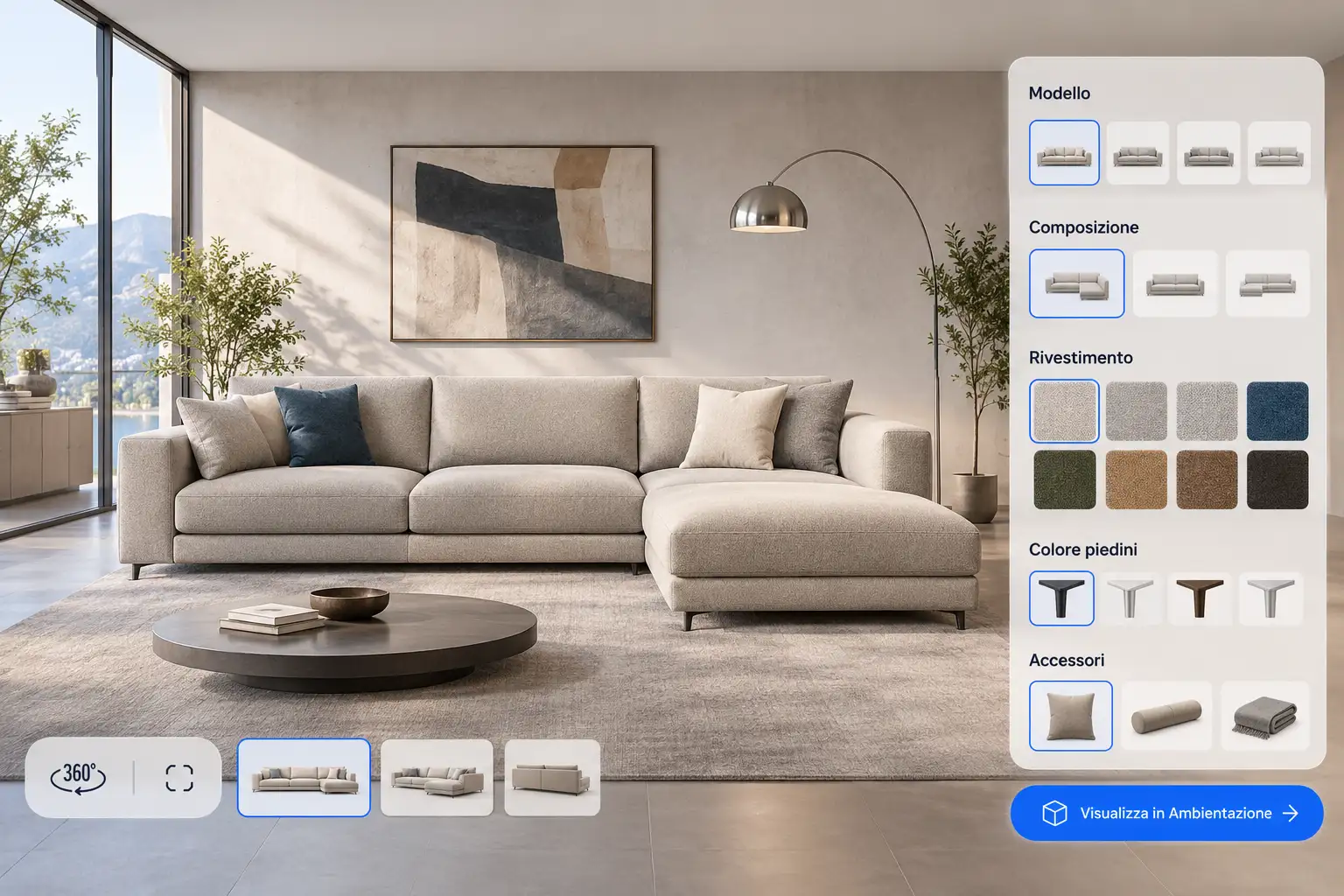
A configurator is an interactive 3D model, viewable in a web browser, connected to a catalog of options. The customer rotates the product, zooms in on the details and changes its elements one at a time, while the image updates instantly. There are two big families:
- Product configurators. The customer customizes a single object: the upholstery of an armchair, the finish of a table top, the legs of a bed, the modules of a sofa, the handles of a kitchen.
- Space configurators. The customer customizes an entire room: the flooring, the wall colors, the tiles in the bathroom, the doors, the lighting, the furniture layout.
In both cases the principle is the same: from imagining to seeing.
Personalization creates value, literally
The most interesting reason to adopt a configurator is not technical but psychological. In a famous series of experiments published in Management Science, researchers Nikolaus Franke, Martin Schreier and Ulrike Kaiser measured what people were willing to pay for products they had designed themselves. The results are striking: self-designed skis were valued at an average of forschung/full-text-papers/frankeschreierkaiser2010designedit_myself.pdf]74 euros against 46 for standard models, and the same T-shirt was worth 6.85 euros to those who had designed it versus 4.75 to those who found it ready-made.
The researchers called it the "I designed it myself" effect. The extra value does not come only from a product that better fits one's taste: it comes from the feeling of accomplishment of having created it. The study also found that the effect grows when the customer has more creative freedom and when the final result is attractive. In other words, a well-designed configurator does not just show a product: it makes the customer feel like its co-author.
Consumer research points in the same direction. A Deloitte study in the UK found that 36% of consumers were interested in personalized products, and 71% of them were willing to pay a premium. The data date back a few years, but personalization has only grown in importance since then.
Fewer doubts, fewer returns
For furniture and interiors, the biggest obstacle to purchase is uncertainty. Will this fabric look the same in my home? Will this table fit? Will the chaise longue be on the right side? An analysis of furniture returns identifies exactly these causes: size mismatches, differences in color and finish, and modular combinations that do not work together in the room. These are precisely the problems a configurator addresses, as long as it uses accurate dimensions and materials that faithfully reproduce the real ones.
The numbers circulating in the industry are encouraging, but they should be read with care because they often come from companies selling these technologies. Shopify reports that products with 3D or AR content show a conversion rate 94% higher, while Snap associates AR-assisted purchases with about 25% fewer returns. A survey by 3D Cloud of 400 US furniture buyers found that 31% of configurator users bought more than they had planned, against 17% of others, and that 74% considered configurators the most useful visualization tool. Treat them as directions, not promises: the actual effect depends on the category, the quality of the tool and the starting point.
Configuring a space: floors, walls and finishes
Configurators become even more powerful when the subject is not a single object but an entire environment. Choosing a floor from a 10 centimeter sample is hard. Seeing it laid across a whole living room, under the light of the windows, next to the color of the walls and the furniture, is a completely different experience.
Large players have understood this. With IKEA Kreativ, customers can scan their own room, erase existing furniture and place new products to scale. In real estate, the Swiss construction company Implenia offers buyers of new apartments a digital configurator to choose between eight types of parquet, ceramic tiles and bathroom fittings, grouped into three price categories. Benefits highlighted: transparent costs for the buyer, better management of expectations and valuable data on customer preferences for future projects.
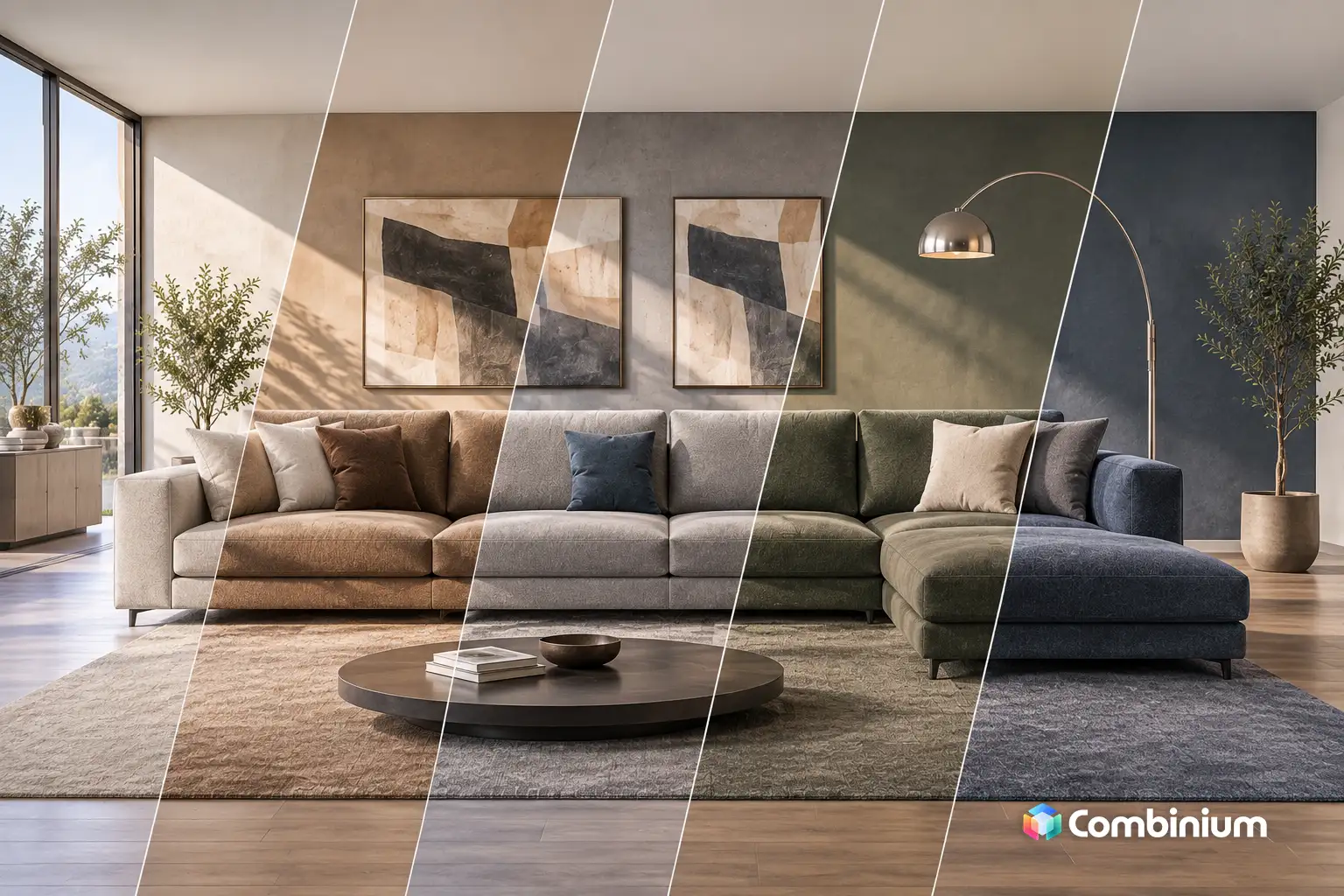
The fields of application are many:
- Real estate developers who let buyers choose finishes, floors and colors before construction is complete;
- flooring, tile and paint manufacturers who want to show their collections in real settings;
- kitchen and bathroom companies that sell made-to-measure projects;
- interior designers and architects who present alternatives to clients without producing dozens of renders.
Why it strengthens brand positioning
Beyond sales, a configurator says a lot about the brand that offers it.
It communicates a premium experience. Offering personalization means saying "we make it for you". It is a message typical of high-end brands, and a configurator makes it tangible from the first click.
It turns the catalog into an experience. Hundreds of fabrics, finishes and combinations become a game of discovery instead of a list of codes. The time spent on the site grows, and with it the emotional bond with the product.
It tells the story of materials. Each finish can have its own story: where the wood comes from, how the fabric is woven, why that marble was chosen. The configurator becomes a storytelling tool for craftsmanship and quality.
It produces valuable data. Which colors are configured most? Which combinations are abandoned before the request for a quote? This information guides collection choices, production planning and marketing campaigns.
It supports the whole sales network. The same configurator works on the website, in the showroom on a large screen, in the hands of dealers and architects, at trade fairs. A single tool ensures a consistent brand image on every channel.
It is a sustainability argument. Fewer returns, fewer physical samples shipped and made-to-order products mean less waste: a message more and more appreciated by customers.

What makes a configurator work
Not all configurators are equal. The ones that really create value share some features:
- Visual fidelity. Materials must look like the real ones, with correct textures, reflections and lighting. A badly reproduced fabric does more harm than no image at all.
- Accurate dimensions. Measurements must correspond to production, not to a generic model.
- Rules and constraints. The system must prevent impossible combinations and guide the customer toward options that make sense.
- Simplicity. Few, clear steps, with sensible default options, so as not to overwhelm those who are undecided.
- Speed on any device. Most customers will start from a smartphone.
- A clear next step. Request a quote, book a visit to the showroom, save and share the configuration, buy.
Toward high-profile custom experiences
The direction is clear: the customer no longer wants to just look at a product, but to make it their own. Brands that offer this possibility not only sell more, but build a more solid and recognizable relationship with their audience.
This is the direction taken by solutions such as Combinium.com, designed to bring customizable 3D products, materials and finishes to the web, and by the virtual tour and digital twin services of ionosfera.dev, which apply the same logic to entire spaces: environments to explore, configure and experience before they become reality. In both cases, the goal is the same: to offer high-profile services and features that turn a choice into an experience.
Would you like to bring a 3D configurator to your products or spaces? Contact us: we can design a solution tailored to your brand.